Use Cases
Consistency is not the same thing as coordination. Coordination depends on people choosing to align. Consistency depends on a structure that holds regardless of that choice.
The environments where that distinction matters most are the ones OMOS™ is built for.
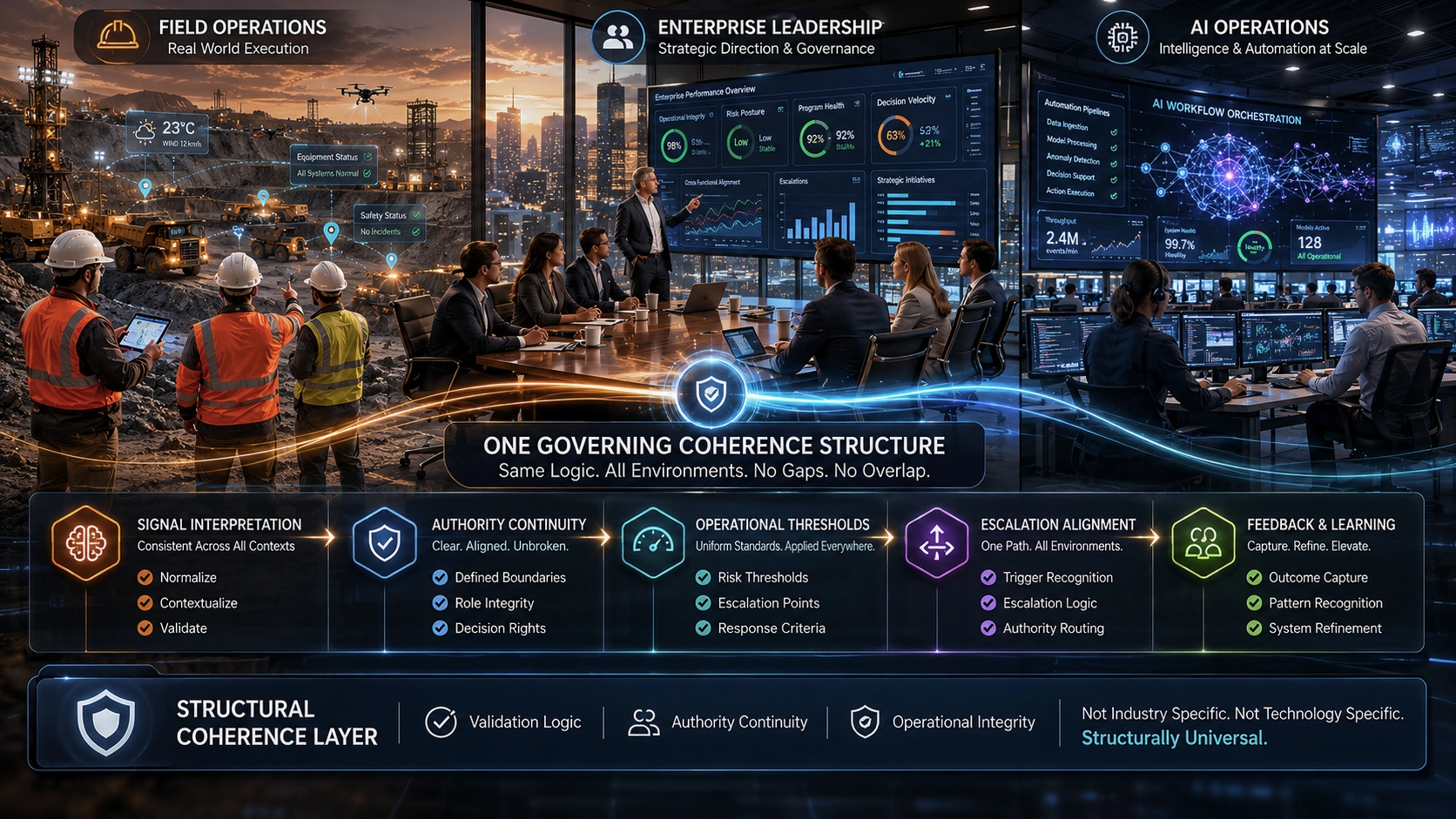
Operational Settings
In operational settings, decisions are made under variability. Conditions shift. Signals must be interpreted in real time, across sites and across teams, by people who may never be in the same room. The expectation is that those decisions align. The structure to ensure they do is rarely defined. When it is, the same conditions produce the same decisions — not because people agreed, but because the governing standard made agreement unnecessary. This is OMOS Governed Execution™ operating exactly as intended, with OMOS Organizational Task Manager™ coordinating and evidencing the work as it happens.
Enterprise Level
At the enterprise level, decisions span multiple systems, multiple functions, and multiple layers of authority. Alignment is expected, but often inferred — held together by organizational culture rather than defined conditions. When that structure is governed, alignment is no longer dependent on coordination. The same decision logic applies across the organization, holding consistency where variation would otherwise emerge. This is what OMOS Decision Governance™ is built to hold — not another layer of process, but the organizational discipline that makes enterprise-wide alignment a property of the structure, not a matter of culture.
AI Governance
In AI governance, the requirement intensifies. Decisions scale. Inputs multiply. Influence extends beyond direct human control. Without a defined governing structure, variation accelerates — and does so faster than human oversight can track. When governance precedes deployment, the system establishes what is admissible, what conditions must be met, and how decisions remain consistent even as they are executed at scale.
The structure holds before the system acts. This is OMOS Governed AI Orchestration™: the constitutional capability through which AI systems operate under the authority of the OMOS System™, ensuring AI-assisted reasoning, collaboration, and decision support stay governed and auditable rather than left to independent AI discretion. It doesn't replace OMOS Decision Governance™, OMOS Assessment Ecosystem™, or OMOS Governed Execution™ — it governs how AI participates inside all three.
One Problem, Not Three
These are not environment-specific problems. They are the same structural problem in different forms: decisions that must align with authority, thresholds that must be interpreted consistently, accountability that must remain explicit regardless of context.
OMOS™ addresses that structural problem — once, the same way, wherever it appears.
Continue exploring: hear how this reads from the seat that has to answer for the outcome in Executive Perspective, or see where OMOS™'s intellectual property stands in IP Portfolio.